

In Esoteric Ebb, men talk to men about manhood, and that's a good thing
It does not shy away from the things many of us are always thinking about when we interact with others, like, “Who are you voting for?” and “What does being a man mean to you?”
It does not shy away from the things many of us are always thinking about when we interact with others, like, “Who are you voting for?” and “What does being a man mean to you?”

When horror speaks in code

It's never too early to start training a baby gamer, right?
It does not shy away from the things many of us are always thinking about when we interact with others, like, “Who are you voting for?” and “What does being a man mean to you?”

It’s happening again: a game that contends directly with manhood, the feminine, and how gender norms intersect with societal structures and systems is being reviewed almost exclusively by men, and those reviews almost entirely ignore the prevalence of gender in the game’s purpose and themes. (Step it up, male reviewers. Do we have to do everything around here?) The game in question is Esoteric Ebb, the new Dungeons & Dragons-inspired, Disco Elysium-like, choices-matter narrative created by Christoffer Bodegård and, in his words, in collaboration with publisher Raw Fury and a bunch of other folks.
Kicking off your first run in Esoteric Ebb is punishingly confusing, particularly if you aren’t familiar with D&D or Disco Elysium, but that’s exactly where my issues with this game end. What you need to know is that in Esoteric Ebb, you can only play as a Cleric; you can make choices later in the game that lead you towards different classes, like Rogue or Druid, but everyone you meet will assume you’re a Cleric.
Like in Disco Elysium, where the protagonist’s abilities are like voices in his head that tell him what to do, Esoteric Ebb’s main character Ragn also has abilities that advise him. But in this game, those voices are the six classic D&D abilities: Strength, Dexterity, Constitution, Intelligence, Wisdom, and Charisma. These abilities speak to you and to one another as they perform saving throws for almost every interaction in the game. They have competing motivations and ideologies, but they always tell the truth. A failed roll will give you limited or useless information, but never false information.
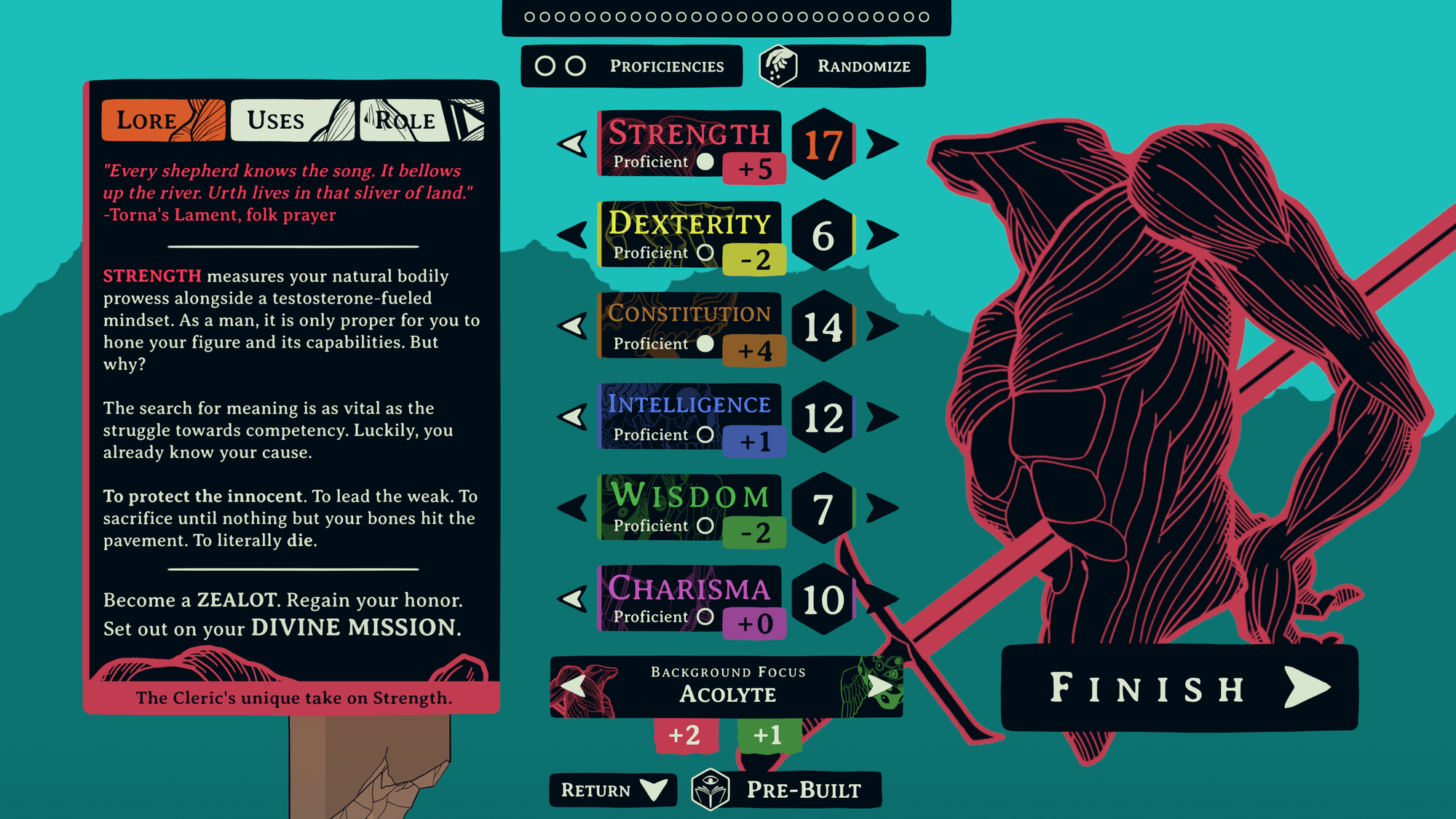
You play as Ragn, a human Cleric who drowned in the river and was then revived. When you awaken after a short cutscene, a minimal tutorial teaches you what to click and when, and then you’re off on your own. Much like Ragn, who has lost his memories, you don’t really know what to do, so you just start poking around. Whatever you decide to do first in the game — you could speak to the undead being who’s stacking apples in the mortuary basement where you woke up, or walk upstairs and start an argument with a kobold, or eat a rotten apple, or pray to the Clerics’ god Urth — it is clear very early on that the concept of manhood is hugely important to whoever Ragn was before the drowning incident. Strength, whose personality aligns with the U.S. Republican-esque Nationalist party, is constantly reminding you to be a man, which in Strength’s ideal, means asserting dominance and upholding the law. Topical.

We can marry whoever we like in Pelican Town, so why no they/them pronouns?


How can a narrative point-and-click make my heart beat so fast?


“I am a woman in her 40s who has the brain of a turnip.”


"It was really hard [...] to be so focused on making a game about queer, trans, POC joy in the midst of so much abject intentional suffering."