

Shapes, not bodies: Queer readings of gaming's oldest avatars
In games like Adventure and Pac-Man, players were used to inhabiting bodies with far fewer defining features
In games like Adventure and Pac-Man, players were used to inhabiting bodies with far fewer defining features

We can marry whoever we like in Pelican Town, so why no they/them pronouns?

"I’m about to make a big life move away from my family into a completely different, opposite time zone..."

In games like Adventure and Pac-Man, players were used to inhabiting bodies with far fewer defining features

In the earliest video games, the player’s body barely counted as a body at all. On screen it appeared as a square, a blinking shape, sometimes just a mouth that opened and closed.
These figures were defined by movement rather than form, not built to express identity or character. They existed because early machines could only manage so much. Memory was tight, graphics were crude, and bodies were reduced to whatever could function inside those limits. The result was a set of avatars that felt unresolved. They had no clear anatomy, no fixed gender, and no backstory to anchor who they were meant to be. Players were asked to inhabit them anyway. Long before games developed a language for representation, early design constraints made space for bodies that were incomplete, unstable, and open in ways later conventions would try to fix.
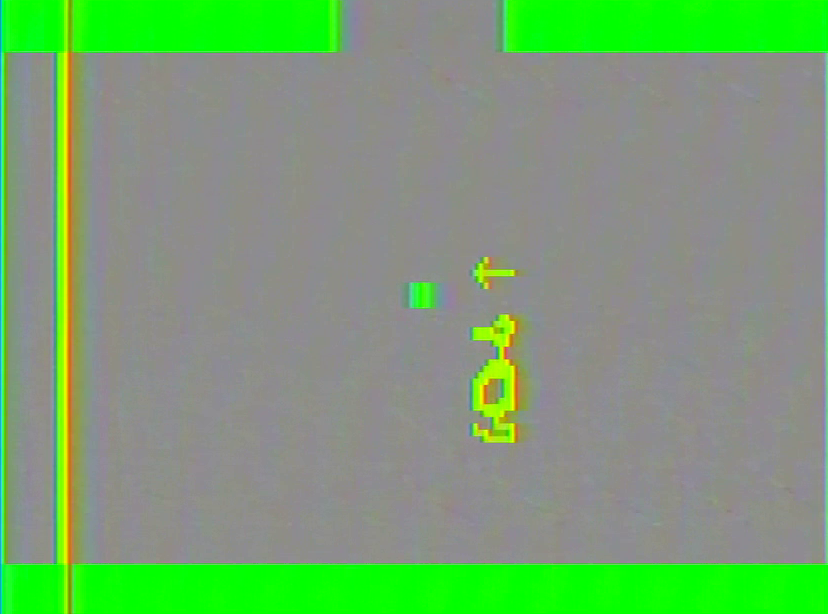
One of the clearest examples of this early abstraction appears in Adventure, released for the Atari 2600 in 1980. The player does not control a hero in any conventional sense. The player’s avatar has no face, no limbs, no silhouette that resembles a human figure. Instead, the avatar is a solid block drifting through castles and corridors, colliding with objects and enemies without ever quite touching them. This body exists only through its capacity to act. It carries a sword, collects items, and survives danger. Yet it never resolves into something recognizable. Its identity is not expressed through appearance, dialogue, or narrative framing; it is produced through action alone. What matters is not who the player is meant to be, but how this shape behaves in space, and how willingly the player accepts that constraint.
A similar tension appears in Pac-Man, where the body on screen is still abstract but begins to attract meaning from outside the game itself. The character in-game is a circle with a mouth, endlessly moving, endlessly consuming, with no clear markers of gender or personhood in the original design. Only later did gender enter the picture, added through marketing and merchandising rather than mechanics, as pink bows and eyelashes were used to differentiate Ms. Pac-Man from the original. The actual character’s body did not change much. The interpretation around it did. What had once been an ambiguous shape was gradually assigned traits, roles, and expectations that the game’s own logic had never required. In this shift, you can see the start of a broader pattern. As game designers grew more confident in their ability to represent bodies, they also became more invested in fixing them, naming them, and telling players who or what they were supposed to be.


We can marry whoever we like in Pelican Town, so why no they/them pronouns?

Developers of games like A Short Hike and Tiny Bookshop weigh in on why even labor feels nice in their games.


How Doki Doki Literature Club exposes dating sims as systems that punish female autonomy
