

How do I get through my gaming backlog?
"I suspect this will be a common affliction among your readership, but my gaming backlog is quite extensive..."
"I suspect this will be a common affliction among your readership, but my gaming backlog is quite extensive..."

How a game that evokes history, rather than merely reproducing it, gets closer to a human truth

My childhood self could never have imagined a game where they got to create a character who was neither a man nor a woman

"Are there any good games, new or old, that encourage learning this mysterious combination of moving, pointing, and shooting that I seem to lack?"

Dear Mothership,
I'm an aging millennial that never developed his FPS skill. I missed the boat when my friends in junior high spent entire weekends at LAN parties emphatically rocket jumping around Quake maps and sniping each other's nostrils with the pinpoint accurate rail gun. I packed my rig and pouted all the way home once I convinced myself that I'd never catch up in skill.
Now imagine all the great games that can be more enjoyable when you have this core competency. Team Fortress 2, Destiny, Deep Rock Galactic, Darktide. I have struggled with perpetual FOMO and tend to play with classes or skills that don't emphasize precise aim or run 'n' gun tactics.
Are there any good games, new or old, that encourage learning this mysterious combination of moving, pointing, and shooting that I seem to lack? Some title out there that escalates the challenge in fundamental ways?
Signed,
Locked & loaded? More like mocked & goaded
Dear mocked & goaded,
Good news: You can absolutely improve at first-person shooters. You didn’t miss the boat; it doesn’t matter when you learned how to play them, or how old you are now. Even better news: You might already be better than you think you are. Based on how you’ve written this letter, I have a strong suspicion that you are, but we’ll get to that in a bit.
First of all, there are many free and low-priced FPS training programs out there, with perhaps the most famous one being Aimlabs. These programs are all pretty similar; they’ll give you exercises you can perform to make you faster at clicking on a head in a video game, as well as drills for other key movement skills, like strafing or rapidly turning around. But Aimlabs and its competitors are pretty damn boring; it’ll be a lot more fun and probably more motivating for you to practice honing your FPS skills by playing actual games.
That’s because the big trick to getting good at Quake, just to use an example from your letter, is to play Quake. That’s it. Anyone can do this, if they choose to devote time to it. (Quake’s modding community has even built tools for blind players!) Back in junior high, your friends had played Quake more than you, and you felt the difference. If you had played more Quake back then, you would have gotten better, and if you wanted to get good at Quake now, you guessed it — you’d need to play Quake.
A lot of what’s important about being good at competitive FPS games is not necessarily aiming, but memory. With practice, aiming will become muscle memory for you. But for multiplayer shooters, the real clincher is actually memorizing map layouts. I’m guessing that your Quake-playing friends back in junior high weren’t all aim gods, per se; they just knew the maps so well that, by process of elimination, they could reasonably guess where their opponents would be located. They knew which windows and doorways their combatants’ heads would most likely pop out from. That is all memorization, which comes with practice. (The YouTuber krucialFPS has a dense but helpful video about how to familiarize yourself with map layouts, if you want even more specifics about exactly what to do in-game.)
None of this requires you having to have started doing it in middle school, though you certainly might have had more free time back then. It just requires you taking the time to work on it. But in your case, I also think there’s something else in play here. I want to talk about the psychology with which you’re approaching this problem.
Lan Party 1999 - Quake 3: Arena
by u/Comfortable-Move3004 in retrogaming
It's been a long time since 1999.
In your letter, you describe a specific experience of playing Quake at a LAN party with other tweens/teens your age and feeling like you weren’t good enough. On the way home, you convinced yourself you’d “never catch up.” It was way back then that I suspect you started engaging in a psychological phenomenon called narrative identity.
Bear with me, I know this is getting corny. But a lot of game skill is, very literally, all in your head.
Back in the day at that LAN party, your Quake-playing friends probably were getting more kills than you. But you hadn’t played it as much, so you weren’t as good. That makes perfectly logical sense, though, doesn’t it? And yet, in that moment, you began to tell yourself a story — a story that eventually became your identity — that you are “bad” at moving, pointing, and shooting. That you could never catch up. And now, decades later, you’re still telling yourself the same story. That you’re behind, that you need some sort of remedial FPS game that will teach you how to develop skills you were supposed to develop as a kid. But all of that is just a story.
You need to create a new story for yourself. It could be one in which you realize that aiming and shooting while moving just take practice, and that you’ll need to choose one game in particular in which to hone that skill and truly devote the time to it. But you could also tell yourself a different story, in which you undo your perception of aiming as the ultimate reflection of true gaming skill.
Aiming has long been considered a very prized skill amongst a certain subset of elitist gamers, and high-DPS character classes also tend to be associated with machismo. Healing, on the other hand, is often denigrated as “easy” and coded as feminine. But playing as a healer in a hero shooter like Team Fortress 2 or Overwatch still requires map memorization as well as movement and positioning skill. The hard part of games like TF2 and Overwatch isn’t necessarily the aiming part, it’s the fact that each character has class-specific abilities, and standing in the right place at the right time during a firefight — as well as knowing when and where to use your special abilities — can make the difference between a win or a loss. DPS players may hog all the glory, especially in games with kill/death splash screens, but don’t let that trick you into thinking they’re more important than healers.
Take Team Fortress 2, which you mentioned in your letter. I’m guessing you gravitated towards playing as the Medic — a character class that doesn’t rely as much on aiming. The other games you mentioned — Destiny, Darktide, and Deep Rock Galactic — all have different character classes in them, too. As you said, you “tend to play with classes or skills that don't emphasize precise aim or run 'n' gun tactics.”
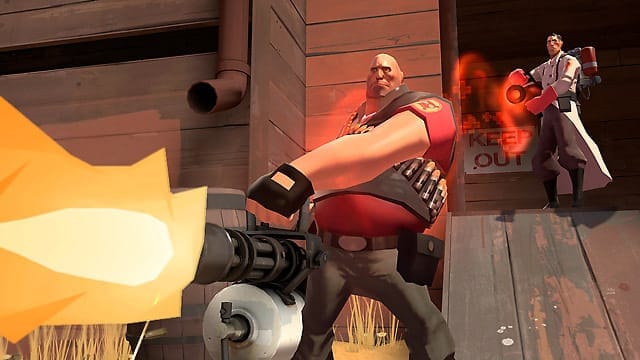
Here’s the million dollar question: What’s wrong with that? This, again, seems like it’s all coming back to that specific moment when you didn’t feel like you were good enough at Quake in your youth. In your mind, perhaps that is what it is to play a multiplayer FPS game: It’s Quake, where DPS reigns supreme, n00bs get pwned, and so on. But in all of the games you’ve listed, there are character classes that don’t rely on aiming, but which are all still valuable to a team of players. That’s a good thing; it means that people who don’t care to hone their head-clicking skills can still play these games and have a great time.
You can, if you so choose, absolutely get better at clicking on heads. The more you play as DPS-heavy characters, the better you’ll get. The more you tell yourself that you aren’t “bad” at it, the more likely you are to find that you aren’t, and that practice was all you really needed. But also, you might just find that you’ve romanticized this particular skill, and that it isn’t really all that much more fun after all.
You’ll also soon find, in these class-based games, that the DPS-heavy characters are the most popular ones, and that matchmaking wait times will get a lot longer for you if that’s how you want to play. That, if anything, is the true evidence that clicking on heads in a video game isn’t really that impressive after all. DPS players are a dime a dozen; a good healer is much harder to find.

"I suspect this will be a common affliction among your readership, but my gaming backlog is quite extensive..."


"Somehow, Outer Wilds manages to fall on the wrong line of all of my game preferences"

"The game coming to an end almost feels like grief. There is an emptiness and sense of loss that I don't know how to fill..."
