

How do I get through my gaming backlog?
"I suspect this will be a common affliction among your readership, but my gaming backlog is quite extensive..."
"I suspect this will be a common affliction among your readership, but my gaming backlog is quite extensive..."

How a game that evokes history, rather than merely reproducing it, gets closer to a human truth

My childhood self could never have imagined a game where they got to create a character who was neither a man nor a woman

By separating aesthetic presentation from player agency, Final Fantasy VII Remake reveals how queerness can be represented without being playable


In 1997, the joke was the man in a dress.
If you grew up playing the 1997 game Final Fantasy VII in the late '90s and early 2000s, you probably remember the moment our brooding hero was asked to trade his sword for a wig. A couple hours into the game, protagonist Cloud Strife and his adventuring party reach Wall Market, where his longtime friend Tifa Lockhart is kidnapped and taken to Don Corneo's mansion. The only viable infiltration and rescue plan involves a disguise. Gamers who reached this section of the game encountered a scene that treated gender nonconformity as strange and uncomfortable: Cloud must cross-dress as a tactical necessity, with player choices shaping the story structure and the acquisition of his limited-edition silk dresses. These varied choices are what made the scene memorable.
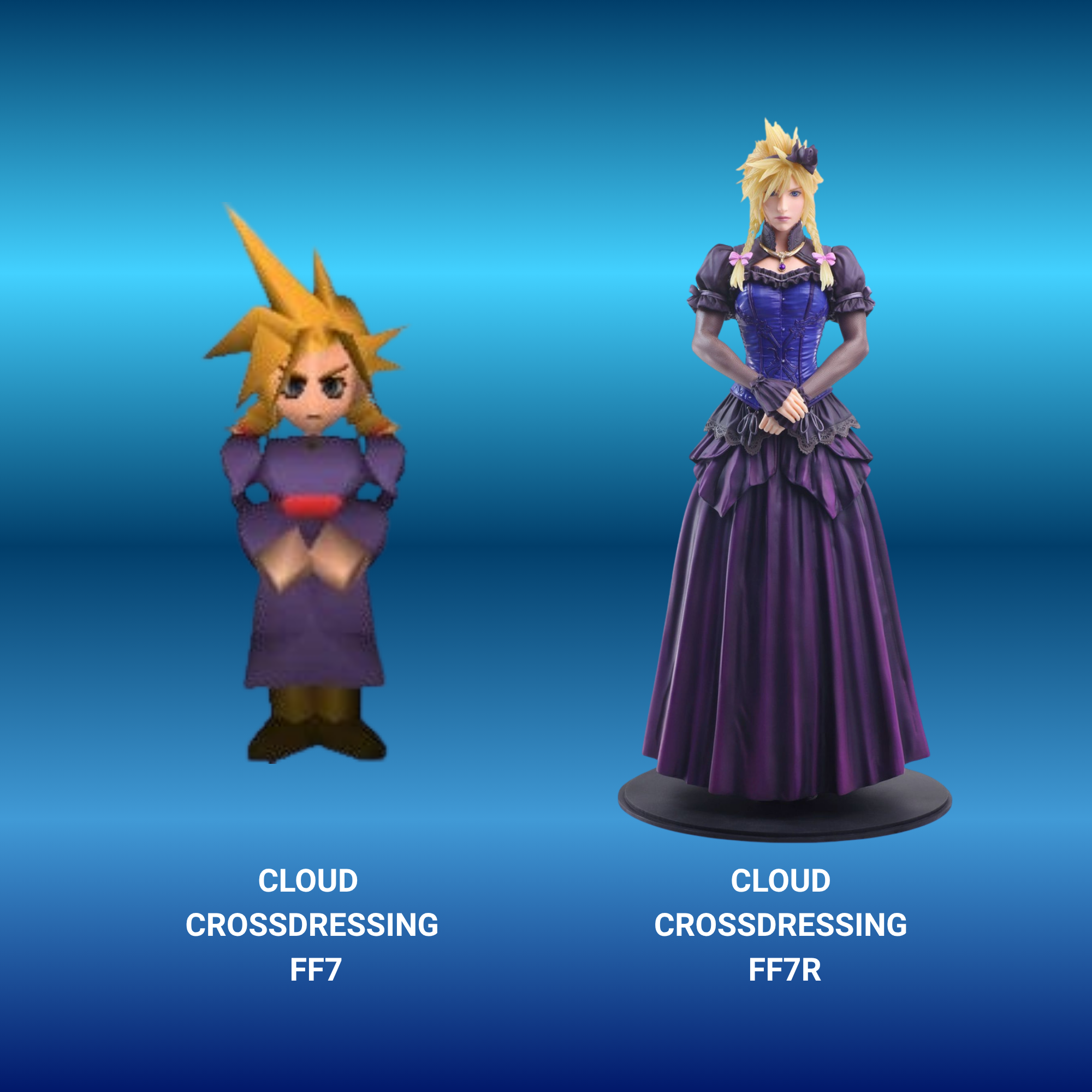
However, FF7’s writing also presented this sequence as comedic, with the humor relying on Cloud’s embarrassment, as well as homophobic tropes and exaggerated reactions from non-playable characters. The cultural assumption of gender representation of the era was that masculinity disrupted by femininity (and vice versa) was inherently absurd; it was often used as a source of homophobic ridicule rather than meaningful character development, reflecting broader patterns in game design where gender representation has historically reinforced restrictive norms rather than challenged them. For many players growing up in the age of iconic films like White Chicks and Mrs. Doubtfire, this style of humor was familiar, yet the topic itself was too taboo to discuss.
In the original “Greatest Disguise” scene, players scoured Wall Market to collect clothing items, negotiated with shopkeepers, and secured cologne and a tiara through fetch quests. The optional Honeybee Inn route functioned as a brothel, where even the Mukki bathhouse scene framed male-male proximity as a source of player discomfort but still rewarded players with women’s accessories. Each task reinforced participation, as Cloud’s disguise was built through interaction, with the intended outcome of fooling a predator and saving Tifa.

How a game that evokes history, rather than merely reproducing it, gets closer to a human truth


A must-play horror tale of transness and tentacles


"I could adopt the form of a woman so beautiful I would shine like the moon..."

