

On Rosalina, the heart of Super Mario Galaxy
An excerpt from Super Mario Galaxy, the upcoming retrospective from author Jordan Minor and Boss Fight Books
An excerpt from Super Mario Galaxy, the upcoming retrospective from author Jordan Minor and Boss Fight Books
The college expulsion, family trauma, and unbridled love behind the Dosa Divas and Thirsty Suitors studio

An excerpt from Super Mario Galaxy, the upcoming retrospective from author Jordan Minor and Boss Fight Books


This story is an excerpt from upcoming book Super Mario Galaxy: The Artistry and Impact of Nintendo's One Giant Leap by author Jordan Minor.
The book is available for preorder in paperback and ebook formats now from Boss Fight Books, with preorders shipping Nov. 30, 2026.
The Mario franchise doesn’t care that much about expanding its roster with fresh faces, at least compared to some other games. However, female characters like Peach, Daisy, Pauline, and Birdo have all brought their own cool and distinct energy that contributes a lot to their respective games, even if fandom’s collective headcanon ends up doing much of the heavy lifting to make up for thin characterization. Rosalina, however, is her game.
Super Mario Galaxy promises a Mario adventure like none before, and Rosalina, the first real, friendly human face you meet after setting foot on these strange tiny planets, guides you into this uncharted territory. In Japan she’s called Rosetta, the name for a type of complex real-world orbital path. Rosalina embodies the game’s spacefaring spirit, the star that the game’s other aspects orbit around.
Rosalina isn’t a damsel you rescue; she’s a goddess you serve. As a celestial Madonna, she towers over tiny Mario with soft but clear authority. Mario looks especially childlike whenever they share the frame. She protects him, powers him up with her magic wand, views his heroic exploits with pride, and gives him all the support he needs to save the universe. If the Comet Observatory feels like a home, it’s because it is one — Rosalina’s home. Mario is just a guest, and Rosalina had a life before he entered the picture. She’s the mother to the Lumas, the star creatures Mario constantly encounters throughout the galaxy. Along with being cute and giving power-ups, Lumas become the very planets populating the universe once they reach adulthood. By rescuing and nurturing lost Lumas, helping them grow up happy and healthy, Rosalina is the reason the Super Mario Galaxy even exists.
It feels appropriate that a figure this overtly powerful is also a bit distant and unknowable, like how you can’t look directly at the sun. What’s Rosalina’s whole deal? Originally, she was meant to be related to Princess Peach, and you can see that in their similar designs. Rosalina’s crown isn’t the only thing that suggests she’s some kind of royal fairy-tale heroine. In a video analyzing Rosalina’s theme music, 8-Bit Music Theory discusses how her song follows the tradition of a classic romantic waltz. “‘Rosalina’s Observatory’ is a beautiful piece of music with a whimsical, dreamy quality that sounds like it was pulled right out of an old Disney movie.” Disney used music to add sweeping emotional heft to its fairy-tale movies, and Nintendo took notes. Koji Kondo’s Rosalina music, which evolves as Mario helps the observatory roar back to life, makes us feel that she’s worthy of our adoration. Like Elsa from Disney’s Frozen, she’s our beloved ice queen.
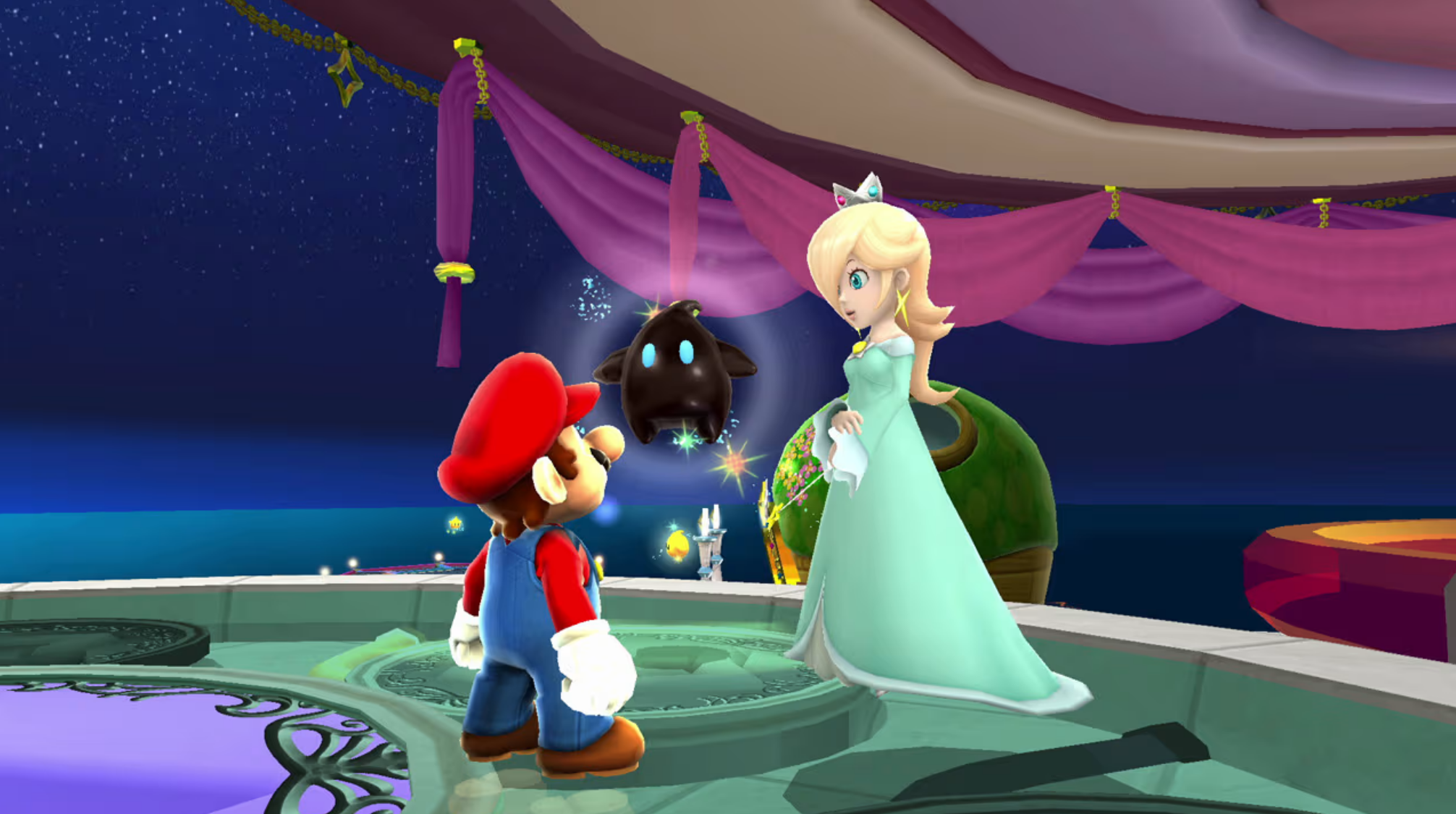
Other touches add to Rosalina’s apparent maturity. Her gown is a pale blue, not a bubbly pink. Her hair obscures part of her face. Her maternal voice is deep and reassuring, not squeaky and grating. Like outer space itself, she’s mysterious. She’s still a cartoon, but her personality traits seem less shallow and loud compared to the personalities of those around her, creating at least the illusion of psychological depth. But she’s no cold, brooding anti-hero. Above all else, Rosalina’s welcoming warmth is what endears her to players, what makes them feel safe in these alien worlds. Rosalina is the affectionate and radiant “Lady of the Shooting Stars,” and thus perhaps the only Mario character that seems like a grown-up, making her an essential component in this child’s bedtime story of a video game.
Super Mario Galaxy opens with storybook pages explaining The Star Festival, a party celebrating the comet that showers Star Bits onto the Mushroom Kingdom every 100 years. It’s during this festival that Bowser kidnaps Peach and everything goes sideways. However, once you get deep enough into the game, you get to read a different kind of storybook. Complete enough levels, and eventually you’ll stumble across scenes where Rosalina, in her bedroom surrounded by curious Lumas, reads from her own storybook. Some players might miss it or not realize that you keep unlocking more chapters as you play, but anyone who hears the whole thing soon understands that Rosalina was Super Mario Galaxy’s true hero all along, and her poetic origin was the real story.
We slowly learn that Rosalina and the Lumas are all orphans. No matter how long they search, their mothers aren’t coming back. But even though one existence sadly ends, we can be happy when new life begins. To demonstrate this, Rosalina’s original Luma transforms from a tiny star child into “a soaring comet that can carry you all on this journey.” Just as the Luma grew into this mighty form, Rosalina eventually evolved into the enigmatic woman we met at the beginning. Only now, after reading her story, we have a new level of empathy for her that, again, feels completely fresh for a plot point in a Mario game. With the story’s final lines, even the Star Festival gains added context and weight. “The comet carrying the Lumas and the girl continues on its journey to this very day. With more ‘family members’ in tow than can be counted, it’s said that the comet visits the girl’s home planet once every hundred years, its proud white tail glittering in the sky.”
Rosalina’s story sees her accepting the death of her own mother and becoming mother to the children of the cosmos itself. Super Mario Galaxy, a project that started out as an experiment to turn spherical objects into cool platforming levels, ends with a gentle, occasionally woeful, but ultimately hopeful meditation on death and rebirth. It tethers the deeply personal with the literal universe. It’s simple enough for children to understand but layered with the subtle, adult sophistication that makes great fairy tales still resonate as people age. Not to get too dramatic, but there’s something almost religious about Rosalina’s fable, a human who went through great suffering and gained understanding so profound they became divine.
Critics like to compare the sparse, reflective tone of The Legend of Zelda: Breath of the Wild (2017) to masterpiece animated films from Hayao Miyazaki. But if Zelda emulates Princess Mononoke, with its epic action and ode to nature, then Super Mario Galaxy is Spirited Away, a softer but no less impactful coming-of-age odyssey blending magical unreality with real emotions about change and responsibility. I honestly still can’t believe it. With this story, Koizumi’s team found a beautiful and elegant way to apply its family-friendly yet high-quality design philosophy to narrative as well as gameplay. By 2007, plenty of gamer parents were ready to pass down their hobby to the next generation and enjoy it alongside them. Super Mario Galaxy is for mothers and daughters alike.

From BossFightBooks.com: "When Mario’s adventures escalated from Bros. to Land to World, the only direction left for an ambitious plumber was up into the stars. In Super Mario Galaxy, defeating Bowser means launching from planet to planet, pausing for just a moment in each Launch Star to wonder what pleasures and challenges await.
The sheer joy of navigating Super Mario Galaxy’s varied, clever, and physics-defining planets to Mahito Yokota’s uplifting score is more than enough to satisfy Mario fans. And to casual players, brought into the hobby through the Wii phenomenon, Galaxy offered new delights beyond motion tennis and bowling. Yet the game also contains a surprisingly sophisticated hidden layer of Little Prince-esque melancholy, beautifully embodied by Rosalina and the Lumas. Director Yoshiaki Koizumi was so committed to the game's emotional core that he developed Rosalina’s heartwarming storybook at night and snuck it into the game without telling his boss, Shigeru Miyamoto.
In this critical and personal appreciation, Jordan Minor takes on a game that influenced his career as a games journalist, offered a chance to bond with his wife, and—after years of watching the game go unsupported on modern consoles—made him a believer in game preservation. Today, with a Switch 2 remaster and a new animated movie out in the world, Galaxy’s legacy has never been more certain."


Dylan never wanted strength, nor asked for any of this

The satirical simulation of urban sprawl is tapping into a deeply repressed instinct to engage in rent-seeking behavior


How a game that evokes history, rather than merely reproducing it, gets closer to a human truth


